Bluegrass: Then & Now
03 Apr 2026
“The music of the mountains, the music of the people” - Bill Monroe
Plateau Magazine April-May 2026
Written By: By Kingsley Guy | Images: photo by bob scott
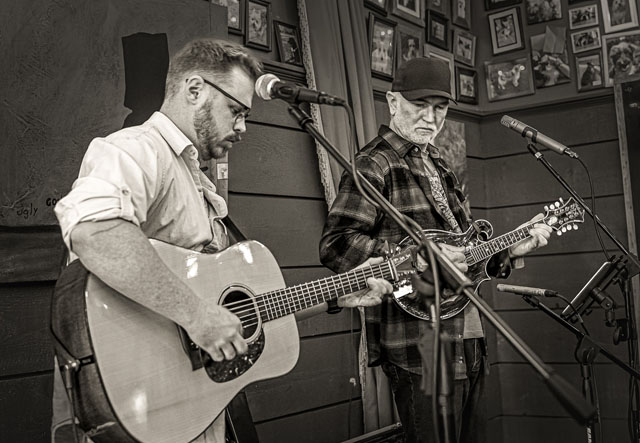
Bluegrass music’s name stems from the bluegrass region of Kentucky, but its heart and soul come from Appalachia, where faith, family, and song enabled people to survive in a hardscrabble land.
Yet, its allure turned out to be universal, and it didn’t remain only in the mountains for long. Today, bluegrass is enjoyed around the globe with a particularly strong fan base in Japan. It even played a political role in the former Czechoslovakia, where young people adopted bluegrass as a form of rebellion against the stultifying communist system of the time.
“Bluegrass has brought more people together and made more friends than any music in the world,” said the late Bill Monroe, known as the “Father of Bluegrass.” Today, the musical style Monroe helped create is often taught in conservatories along with Mozart and Bach.
Monroe, born in Kentucky, formed the band “Bill Monroe and the Blue Grass Boys” in 1939 and introduced the bluegrass genre to the musical scene. He sang, composed songs, and played the mandolin, one of the five foundational instruments of traditional bluegrass. The others are the five-string banjo, fiddle, guitar, and upright bass (Note that in traditional bluegrass, there are no drums or electrified instruments).
In 1945, the great Earl Scruggs joined the Blue Grass Boys, bringing with him the revolutionary three-finger banjo picking style. The finger dexterity required for bluegrass is so extreme at times that it seems to border on the impossible, but as Scruggs noted: “If you’re going to play the banjo, you have to let it roll.”
Bluegrass itself may be less than a century old, but its roots stretch much deeper into the past. When Scots-Irish immigrants came to the Appalachian Mountains in the 1700s, they brought with them sometimes uplifting and sometimes mournful ballads. These heavily influenced Monroe’s much-copied singing style that has been described as a “high, lonesome sound.” The Scots-Irish also brought their fiddles and raucous renditions of songs that influenced the development of bluegrass.
The banjo is the only instrument in traditional bluegrass that didn’t come from Europe. Stringed instruments made from gourds and covered with animal skins crossed the Atlantic from West Africa during the slave trade. They evolved into the banjo in the Caribbean and the plantation South. Eventually, the banjo made it up the mountains, and its use in bluegrass adds to the cross-cultural richness of the genre.
Appalachian life was all but synonymous with religion, and the hymns of the Scots-Irish Presbyterians and Baptists gradually transitioned into a gospel harmony that formed an integral part of bluegrass vocals. In some songs, one wag quipped, “Bluegrass serves as a church without walls and testimony without a pulpit.”
Like all art forms, bluegrass evolved. In the late 1960s, “doggrass” or “dawggrass” leapt onto the scene. It retained the traditional acoustic instruments of bluegrass but explored jazz chord structures and swing rhythms, becoming more harmonically adventurous.
“Doggrass was a transition into newgrass,” explains Michael Hall, a man with an encyclopedic knowledge of music who has owned and operated Tempo Music Center in Hendersonville for the last five decades. Newgrass often added drums and electronic instruments and expanded on the genre-bending initiatives of doggrass.
Hall points out that the late Jerry Garcia, the lead guitarist and singer of the Grateful Dead, started out as a bluegrass banjo player and was instrumental in the development of newgrass, a fact even some devoted Deadheads might not know.
“I’m always pleased to hear musicians who are keeping the old bluegrass traditions alive,” Hall says. Yet, he’s not one to complain about the evolution: “The changes broadened the bluegrass appeal to younger people and helped the music to survive.”
The Highlands-Cashiers Plateau played a role in shaping bluegrass in its early days. Local musicians gathered in Helen’s Barn in Highlands, now the Asia House restaurant just off Main Street. Music and dancing flourished there, and musicians let it rip as they explored the bluegrass genre.
At the same time, more and more people from big cities of the South were making Highlands and Cashiers their summer home. Many were attracted to bluegrass and hired local musicians for private events. The newfound prosperity helped the bluegrass musicians of the Plateau sustain themselves.
Down the road, high-brow, classically oriented music students and professors from around the country descended each year for the Brevard Music Center Summer Festival. Many were attracted to bluegrass and admired the quality of the musicianship. They often joined locals for jam sessions and helped popularize bluegrass when they returned home.
In Asheville, musicians of the 1960s counterculture discovered bluegrass. As in other aspects of their lives, they pushed boundaries and contributed to the evolution of bluegrass.
Outside of Asheville, public radio station WNCW had a strong signal that even reached neighboring states. It’s programming focused on mountain musical traditions and helped broaden bluegrass’ appeal.
Musicians in the Highlands-Cashiers-Brevard-Asheville corridor felt free to explore the bluegrass genre without the commercial and recording restraints imposed by Nashville, thus helping to drive the evolution of bluegrass. That influence survives in Brevard’s annual Mountain Song Festival held each year in September. It draws visitors from far and wide, helping to keep bluegrass and other mountain musical forms alive and vibrant.
There are common threads to bluegrass and its evolving iterations: They require quality musicianship, and above all, they’re fun. As Bill Monroe said, “If you can play my music, you can play any music.” That helps explain why bluegrass has always brought cultures together rather than driven them apart.
Bluegrass continues to entertain audiences across the Highlands-Cashiers Plateau. Please refer to our Events section for information on upcoming events.
Bluegrass:The Future
The Tan and Sober Gentlemen are causin’ a musical ruckus
By Emily Davis » Photos by Craig Shaffer
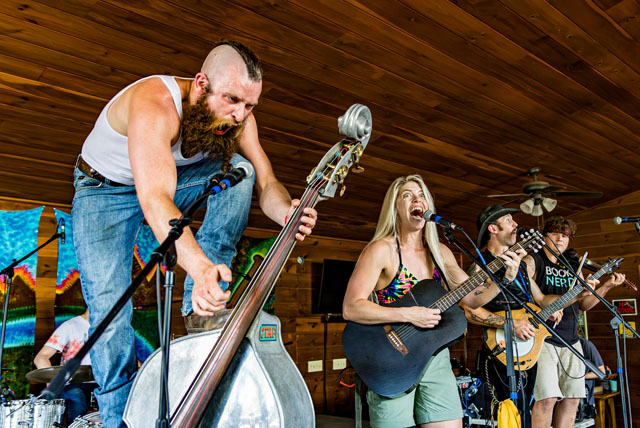
Exploding bass strings, ripping shirts, and prosthetic legs crowd-surfing to the stage…This ain’t yer grandpappy’s bluegrass band.
Bluegrass has enjoyed a resurgence of popularity in recent years–harder, faster, and wilder than ever before. The Tan and Sober Gentlemen, with a style best described as “Celtic punk grass,” are blazing the way for a new generation of down-home musicians with a rock-star flair.
Hailing from Snow Camp, North Carolina, bassist Ben Noblit grew up in a family that plays old-time music, “what happened the first time the Irish fiddle met the African banjo, somewhere in the Carolinas before the Revolutionary War. It is the first American music.”
Those musical beginnings brought Ben into the 2010s, when inspiration took root. Struggling through the after-effects of a traumatic brain injury, he found a second home at Irish pub Tir Na nOg in Raleigh, a place he describes as “the center of Irish music in the state at the time.” It was there that Ben met the woman he now calls his godmother, Annie Britton, of Camlough, South Armagh.
“She took me under her wing and opened my eyes to the wonder and joy of Irish traditional music,” he recalls. “That music, though separated by an ocean and several centuries, was the same thing at the core as the music I grew up playing at home. It carries the story of who we are as people, and the journeys we took to get here.”
It was that distinct Irish flavor and passion for the culture that drew my attention to the Tan and Sober Gentlemen. My first experience with the band was in May 2024 at The Outpost, overlooking the French Broad River in Asheville. As grey clouds loomed and thunder rumbled ominously, the band played on, unbothered by the threat of imminent downpour. The audience, some of us barefoot in the mud, danced as though the pied piper were playing. Later that night, the aurora borealis lit up the Appalachians in a rare display of celestial power.
Another time, I trudged through bitterly cold winds and blowing shards of sleet to see them play at Jack of the Wood downtown. After a lively show that invigorated my spirit, I emerged near midnight to glistening ice-covered sidewalks.
If I suggested the band’s energy could influence the weather, most would call me crazy. Go hear the Tan and Sober Gentlemen for yourself, and you might find that you agree.
Each show begins with an impassioned plea to the audience: You cannot sit. “We will be personally offended if you do!” Ben is joking, of course, because it’s an instruction the audience hardly needs. Once the band launches into Waterbound, you won’t be able to sit. Or stand still.
One guy, apparently, even happily danced a leg off. Search the band’s Facebook page for a video of an all-time favorite moment, in which a fan crowd-surfs their prosthetic leg to the stage. The gesture was a bit off-kilter, just like the Gentlemen themselves, and perfectly encapsulates the humor and banter they exchange with their crowds.
A Tan and Sober show brings electric energy, but the music reflects a Gaelic soul. Whether you’re of Irish descent or just wish you were, you will laugh when the band announces the “Irish National Anthem”… and then launches into their rendition of Rattlin’ Bog. By the end of the song, the wheels come off the bus in the very best way. If you’ve had a few pints of brew by that point–another thing that, I would argue, should be required– you’ll no doubt find yourself singing along.
What would an Irish-inspired band be without a trip to Ireland? Lead vocalist and guitarist Courtney Barefoot recalls one of her favorite memories: After falling in love with a video of Luke Kelly singing The Town I Love So Well, written for him by Phil Coulter, she marveled at the passion and strength of the performance. “I got to learning it,” she shares. And then she sang it that summer when the band toured Ireland. “I was quite nervous because it is such a well-known and respected piece, but getting to play it with my friends, along with the people who lived it and see the passion they sang with…there’s no comparison.
Violinist Eli Howells agrees that, “playing with Tan and Sober has been the weirdest dream come true for me. From being hoisted onto an Irishman’s shoulders to sing Dirty Old Town in the Fleadh Cheoil to limping an old school bus through rural Florida, I can’t count how many wonderful memories we’ve been able to grow and how much fun we’ve had along the way. It means the world to me to see people having as much fun as we do when we play.”
Tucker Galloway (lead vocals and banjo) chimes in on the weird, wild fun that is touring.” I get to play music with the people I care for and have made my life possible…Everyone respects and loves each other for who they are. And to be able to perform and make music and bring others together with them is something I wouldn't trade for the world.” It’s clear that the love runs deep–for one another, for the fans, and especially for the music that brought the band together.
Bill Monroe once said, “I was determined to carve out a music of my own.” It seems the Tan and Sober Gentlemen have decided to do the same.
With shows all over the Southeast and beyond, you can find the Tan and Sober Gentlemen sawin’ on a fiddle and playin’ it hot (yes, Eli kills it) at a festival, pub, or dance hall near you. I can’t make any predictions about the weather, but I can promise you a great time, sore feet, and a joyful Gaelic heart. Bring yer grandpappy, if you can. Y’all might even become part of the ruckus.
The Tan and Sober Gentlemen is composed of Courtney Barefoot (lead vocals and guitar), Alan Best (mandolin, accordion & whistle), Tucker Galloway (lead vocals and banjo), Eli Howells (violin/fiddle), Ben Noblit (bass), and Jake Waits (drums). Their debut album, Veracity, was designated by Shite’n’Onions as one of the five best Celtic punk albums of 2019–2020. Regressive Folk Music followed in 2022, and Live at the Haw River Ballroom, recorded in front of 800 lucky fans in Alamance County, North Carolina, was released in February 2025.
Check the band’s website at tandandsober.com for a schedule, merch, and more. Follow them on Instagram @tanandsober, on Facebook at www.facebook.com/tanandsober and stream their albums on Spotify.