Calling of the Clans
03 Jun 2026
Getting the craic on this year’s gathering at Grandfather Mountain Highland Games
Plateau Magazine June-July 2026
Written By: By Stuart Malcolm Ferguson | Images: Photos by James J. Shaffer; Frank Brady
Better than Brigadoon, which appears but once a century, and only for a day (according to Lerner and Loewe’s musical), the Grandfather Mountain Highland Games come every summer; in 2026, most things Scottish will be celebrated Thursday through Sunday, July 9-12, in Linville, North Carolina. If you’re a fan of bagpipes and bare knees, you’re in heaven all weekend. If not, there’s always the Gaelic Sing Along on Friday, or let the sounds of Saturday’s harp competition soothe your soul, and there are sheepherding demonstrations every day.
Whatever your tastes, the games are well worth the trip from our plateau: First of all, MacRae Meadows is a stunning site, nestled under the looming 5,946-feet-high, majestic Grandfather Mountain itself. In the center of the Meadows is a low, natural amphitheater, around which scores of colorful tents are erected, athletic and dance competitions held, and bands and clans parade. A significant portion of Carolinians trace their ancestry to Scotland, and thousands of happy visitors, wherever their forebears hail from, will bask in the panoply of kilts, tartans, and bonnets. More than one hundred clans and family associations have representatives on hand at the Meadows to welcome you.
Merchants are offering Highland dress and historical costumes, jewelry, camping supplies, books, musical instruments, and—this could be great or bring a lot of tears--Compleat Knight, A Children’s Armory.
The Scottish Cultural Village offers lectures and demonstrations on Highland dress, the Hebrides Islands, Scottish Witch trials, and distilling, among other topics. There’s plenty of food—and whisky-tasting seminars on offer. You can camp out, too. This year’s Chieftain of the Games will be David Gunn of Gunn, chief of Clan Gunn.
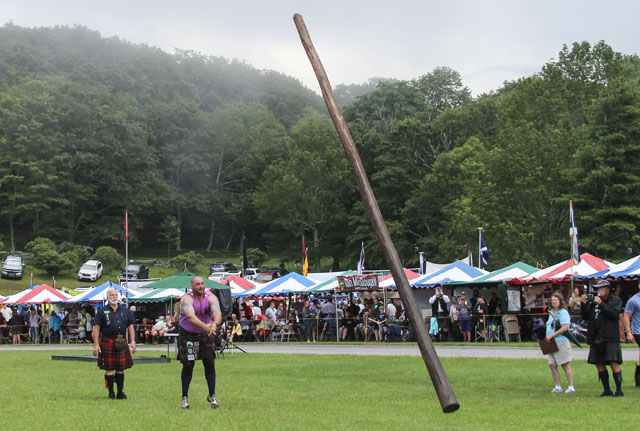
The athletic and artistic contests astound. Your correspondent has been twice, and it’s something to behold as the burly lads—and now lasses!—throw Scottish hammers and toss sheaths. Of course, the crowd pleaser is the caber toss, said to derive from hauling timber out of the Highland forests and trying to get it across streams or gullies, done by turning the wood caber—which can be 20-feet long and weigh 150 pounds—end over end.
“A perfect throw is when the caber lands in the twelve o’clock position after being thrown in a vertical semi-circle,” says The Silver Bough, a four-volume compendium of Scottish folklore compiled by F. Marian McNeill. “The test is not in how far to throw it, but in how straight a line.”
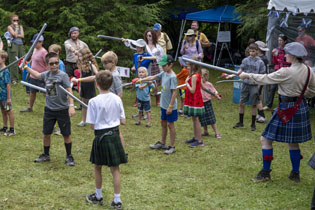
There are also wrestling and foot races for amateurs and professionals, adults and kids. Highlands historian Ran Shaffner says the thrill he and his sons had at the Grandfather Games was “not only watching the field and music events but also participating in them. We ran the kilted mile, having borrowed kilts from friends in Highlands, which reached the boys' ankles but didn't stop Ted from placing in the event.”
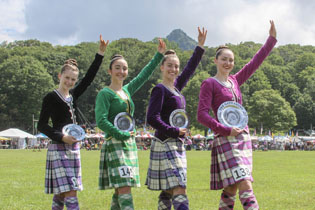
The dancing competition features jigs, strathspeys, the Highland Fling, and sword dance, among others. Then there are the contests among pipe bands and individual pipers. As The Silver Bough puts it: “the pipes have their own classical music—the piobaireachd—which requires great natural aptitude and long and arduous training. This esoteric music only the initiated can fully appreciate.” You may concur, but give it a hearing.
For many years, Tim Chambers, along with his father and cousins, played in our local Highlands Pipes and Drums, which was organized in 1988. The band performed at Highland gatherings around the country but, strangely, not at Grandfather Mountain. However, their handsome tartan was personally chosen by Dr. Gordon Teall, Laird of Teallach and president of the Scottish Tartans Society, who was in the U.S. because Highlands was originally chosen as the site of the Scottish Tartans Museum, now located in Franklin, and Highlands Pipes and Drums was a sort of house band.
Chambers remembers, as a young teenager, attending the gathering in Linville with his increasingly Scottish-obsessed family, but as civilians, not musicians. “The fanfare—the sheepdog contests, the sword dances, and the massed bands were all so much fun!”
This year, there will be five pipe and drum bands, including host band Grandfather Mountain Highlanders. If your blood doesn’t stir when they all come marching in their finery, you’re probably dead.
When it comes to Caledonian fandom, don’t leave out Cashiers Valley. In the 1870s, when Congressman Armistead Burt owned the Zachary-Tolbert House—now the centerpiece of the Cashiers Historical Society—he entertained his guests by reciting Sir Walter Scott’s poem “Marmion” on the porch at sunset: “There are maidens in Scotland more lovely by far/ That would gladly be bride to the young Lochinvar.” (Burt’s bride was one of John C. Calhoun’s nieces.)
The very first Highland games held at Grandfather were in 1956, though the be-tartaned tradition as we now know it started in Scotland in 1819. Yet, according to The Silver Bough, “…meetings for games and sport have been held on the Braes of Mar for over a thousand years.” That gathering near Balmoral Castle is still held every September, and it was there at Braemar that the Earl of Mar raised the royal standard of the exiled Stuart claimant to the British throne (known as the Old Pretender) on Sept. 6, 1715.
We’re getting into the heather here, because the first 1956 iteration of the Grandfather Mountain games took place on August 19, chosen to commemorate the exact date in 1745 when dashing and doomed Bonnie Prince Charlie (aka the Young Pretender and son of the above) raised his father’s standard at Glenfinnan on the West coast of Scotland. Later, the Grandfather Mountain games would be moved ahead a month.
Co-founders of the Grandfather Mountain games were Agnes MacRae Morton and Donald F. MacDonald. In 1885, Mrs. Morton’s father, Hugh MacRae (whose family emigrated from Scotland to Wilmington in the 18th century), bought 16,000 acres, including Grandfather Mountain, and founded the Linville Improvement Company. In her 1913 travel book The Carolina Mountains, Margaret Morley of Tryon wrote of visiting Hugh: “There are peacocks at MacRae’s, and Mr. MacRae has not forgotten how to play on the bagpipes those ancient airs that have so stirred the blood of his race. One of the pleasant memories of this side of the Grandfather Mountain is Mr. MacRae walking up and down before his house playing the pipes. But you will have to coax him to do it.”
Mr. MacDonald, a journalist in Charlotte, had attended the Braemar Gathering a year or two before and came back across the Atlantic enthusiastic to stage a similar event in North Carolina. In fact, MacDonald was so enamored with all things Scottish that he married a Gaelic folksinger from the Hebrides and moved to Scotland with her. (Hmm, it does sound a little like Brigadoon.)
It's said that Dr. Teall chose our area for the Tartans museum because he was a fan of Bluegrass, and among the many performers this year from both North America and Europe are musicians from or inspired by the Southern Appalachians (Voices of Valverda); as well as the Celtic diaspora (Seán Heely Celtic Band, Émigré, fiddler Mari Black, and StrathSpan, who aren’t afraid to go a little Nordic, too); more specifically Scottish (Ed Miller Trio, Nick Hudson); Rock groups (Seven Nations); and guys who rock the 18th-century (Tune Shepherds).
The whole affair gets underway Thursday evening with a torchlight ceremony, and everyone is encouraged to bring a picnic; the Kirkin’, a Presbyterian worship service, is Sunday morning, followed by the Parade of Tartans. Sunday is also Family Day, when it’s even more child-friendly than the earlier days, and kids can participate in most of the activities.
Worried about kilt etiquette? Good news! You don’t have to be Scottish to wear one. However, in British Highland Regiments, tradition is strictly enforced: Before military parades, sergeants major sometimes clip a car mirror to a marching stick and hold it under the kilts of their men to “check they are suitably undressed.” It’s up to you….
Visit the Grandfather Mountain Highland Games website at https://gmhg.org/, or call (828) 733-1333 for more information.