Making Metaphors
03 Apr 2026
PLATT Architecture’s Bridgehouse in Cashiers
Plateau Magazine April-May 2026
Written By: By Kristin Landfield | Images: Photos by PLATT Architecture
For those of us who like to ramble the trails of the southern Appalachians, the simplest of bridges can be a revelation: a fallen log offering clear passage. After a big spring rain, rushing streams roil and chatter around great tumbles of mossy rock. Our eyes lock on a sturdy log, and we tiptoe our way across, arms akimbo. With a few light skips, we find ourselves on the other side, victorious in our still-dry boots. We made it…We connected.
Bridges are inherently symbolic. They appeal to the part of our humanity that seeks connection, union, possibility, and novelty. By their form and by their function, by moving us from “here” to “there”, bridges express a narrative. Moreover, they offer us new points of vantage that are otherwise inaccessible from our grounded stations. For PLATT Architecture, one bridge offered a solution: it engineered a way to connect disparate spaces, to unite something old with something new, and by using cables and trusses, to convey a sense of welcome.
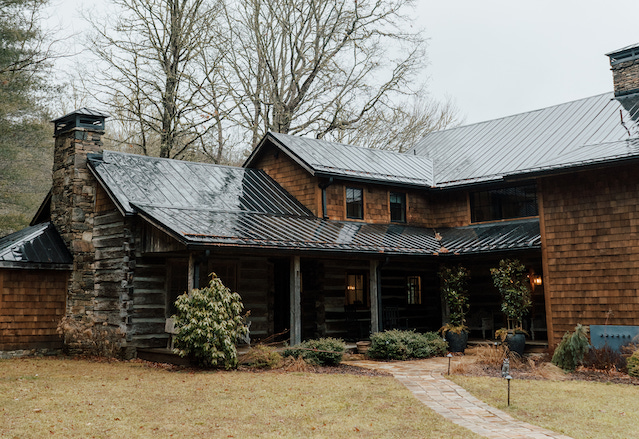
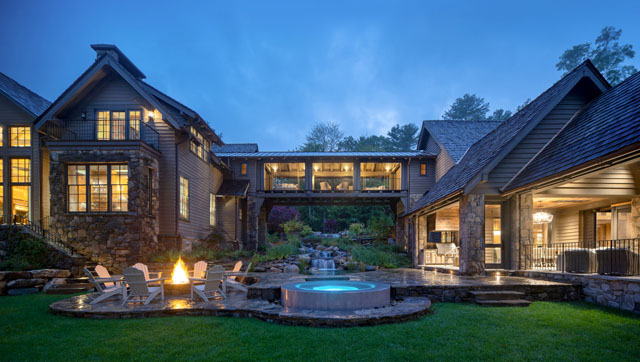
PLATT Architecture’s Bridgehouse in Cashiers, North Carolina, was an unusual project, says principal Parker Platt. In 2012, the homeowners worked with PLATT to complete a home in Mountaintop. A decade later, they returned to the Platts, having purchased the adjacent lot with the intent to build a guest house. They wanted a home substantial enough to accommodate their children and grandchildren, rather than just a connecting guest suite. This meant designing an independent yet complementary structure. Parker and his design team wondered whether they could link the two homes with a bridge. Feasibility studies proved the concept would work. The clients engaged builders Sadlon and Associates to execute the task. To ensure structural integrity, they craned 40-foot-long trusses, fabricated by Big Timberworks in Montana, into place. The bridge became the central theme from which much of the home’s living space radiates.
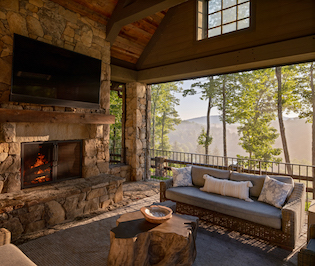
A signature feature of PLATT’s work is how well it responds to both the site and the broader context of the site—the place. The firm designs in conversation with the land; they express a desire to listen. PLATT’s form language speaks a local vernacular; its tone is poetic rather than polemic. Parker likes to ask, “What does this site want us to do, and how do we put our clients on the site in a way that also preserves it?”
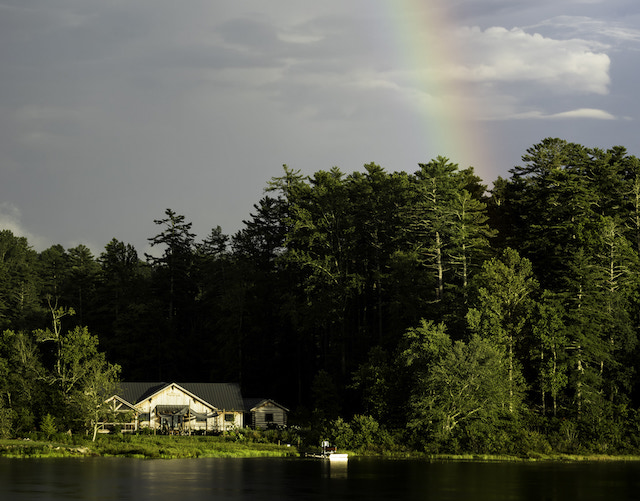
Being a Brevard-based firm from a Brevard-based family, PLATT recognizes that their clients choose a location because they love it. Even on ambitious projects with large structures, they avoid plopping a grand home on a lot. Bridgehouse is a keen example. Instead of divorcing the shelter from the outdoors, this design, with its careful orientation and spatial detail, enhances a bond with the landscape. By entering the home from an upper level, there is better access to natural light. There is more immediacy with the outdoors when the architecture engages the contours of the land. It feels natural; it brings ease.
When developing the outdoor spaces at Bridgehouse, the team knew that the challenge was to form cohesion between the two homes on the ground plane. The guest house should not look like a new appendage. PLATT sought to maintain some experiential separation between the homes without leaving a dead zone below the bridge. In response, they introduced a significant water feature, creating sensory dimension and excitement.
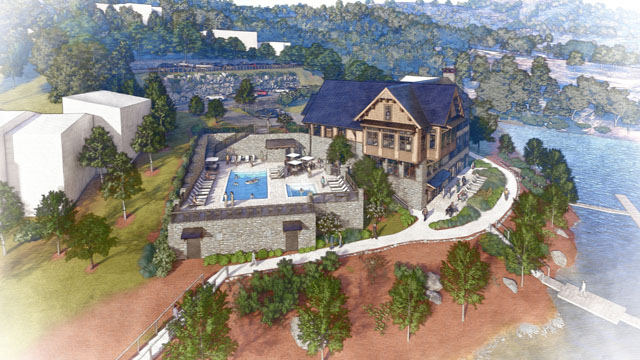
Landscape architect Matt Fusco worked with PLATT to design the striking element and develop the surrounding landscape, resulting in a vibrant feature that moves water through the clients’ primary living space. A masonry-clad rectilinear pond serves as the water’s origin, which then spills through the landscape toward the spa at the base. Rhythmically placed rocks and cheerful aquatic plants punctuate this more structured portion, from which water then cascades in a more organic creekbed sequence. In this naturalistic segment, the design exploits the site’s sloping contours. Water funnels downhill in a series of drops that generate sound and mist, reinforcing the ambience of a mountain stream. Although the feature is a clear abstraction of Jackson County’s abundant waterways, it pays homage to the surroundings and serves to connect the family to the special region.
Bridgehouse’s water feature was no small act of engineering. The feature’s large format dictated an elaborate infrastructure with a 7,500-gallon underground cistern hidden behind a retaining wall. Rainwater from the roof feeds into the cistern. Incidentally, a cart path bridges the water feature for yet another channel between the homes. Loose plantings on the low side of the retaining wall further soften mechanical aspects. At the bottom of the cascade, the stream appears to enter the spa. In fact, a drain separates the stream water from the spa water. Fusco designed a small bridge to mask the drain, demonstrating another instance where a bridge creates both connection and distinction. By gathering water in such a dynamic way, the stream motif commands our attention, and hopefully, family and friends gather around to enjoy it.
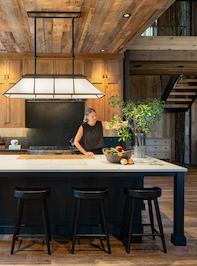
By now, it must be apparent that this project was a joyful act on the part of the homeowner. They wanted a fun home where their grandchildren could visit and feel free to roam. They wanted an approachable, casual, and durable home that offered opportunity for connection, as well as ample space for comfort. Jackson Platt’s interior design director, Katie Jackson, listened to these desires and interpreted them with ease and elegance. Every sophisticated material is likewise durable: sturdy furnishings, exterior fabrics that can handle the occasional spill, and rugs all made for indoor-outdoor use.
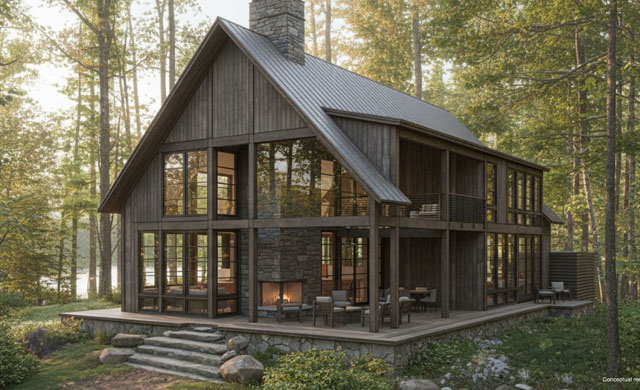
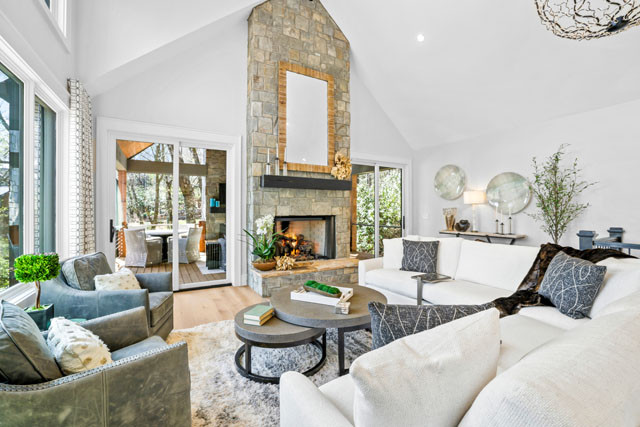
In the common spaces, Bridgehouse’s color palette is anchored by rustic hues. Darker notes balance high ceilings and abundant light. An upper gallery mimics an elevated bridge, again referencing the home’s defining feature. Hemlock walls and brushed hemlock ceilings govern the common spaces with warmth and richness. The effect is confident and restrained, unfussy. Katie resisted the urge to clutter the walls; the material and craftsmanship are ornament enough.
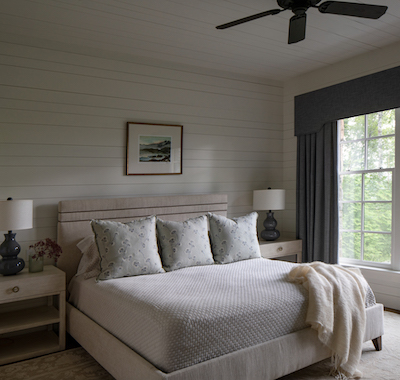
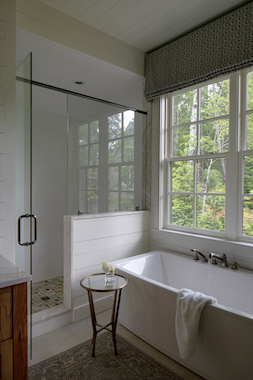
Nevertheless, there is nothing spartan about the space. The large game room, with its well-appointed bar, custom air-hockey table and foosball pitch, invites raucous contests, offering plenty of space for family to join. The sweet bunkroom evokes thoughts of bedtime stories and smiling goodnight kisses. It is dreamy. In all the bedrooms, Katie opted to lighten the walls with a creamy white shiplap. She also reduced the visual weight of the furnishings by selecting finer lines for the bedframes. This subtle shift communicates a calm airiness: it promises a good night’s sleep.
Outside, the bridge itself presents another serene sleeping spot, with two large swing beds ready for napping. A set of adjacent club chairs offers a meeting point to share a cup of coffee and greet the day. These spaces voice invitations; they say, “gather, please linger.” They give you what Frank Lloyd Wright described as “not just a place to be, but a way to be.”
On this project, Parker and team worked closely with the client to answer one key question: “How should it feel?” With engineering, a vision and hordes of talent, they built a bridge to find that answer: It should feel like “home.”
For more on PLATT’s impressive cache of projects and talented team, see their website www.platt.us. Also, visit their Pieces Interiors Boutique for inspiration and curated home furnishings: 46 W Jordan Street, Brevard, NC 28712