Pets With a Purpose
03 Feb 2026
A small family farm creating big change
Plateau Magazine February-March 2026
Written By: By Emily Davis | Images: Photos by Bob Scott
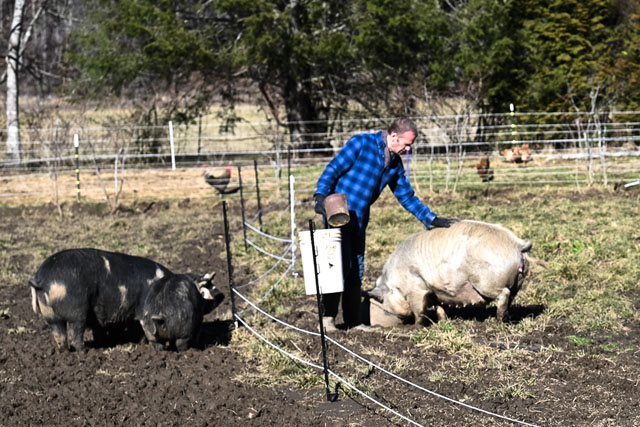
When most families plan for dinner, they head to the grocery store. The Alisons look to their backyard. Jeremy and Natalie Alison, along with children Evalyn (13), Barron (12), and Ally (9), have poured years of love and labor into four acres of lush valley outside Franklin, North Carolina, transforming the land into a legacy of hope for the future.
Called Able Farm on the family’s Facebook and Instagram pages, the homestead’s name originally derived from a common Biblical theme of empowerment, the idea that we are made able to do all things. Over time, Natalie also realized the name stands as an acronym for Ally, Barron, Love, and Evalyn.
The farm, framed by rolling mountains and bordered by a creek where the family tubes in the summer, comes to life each morning with the sounds of crowing, bleating, mooing, oinking, and gobbling. Jeremy and Natalie head outside to check on the animals, then report to their day jobs – he, to his home office where he works as a commercial audiovisual engineer, and she to homeschooling, cleaning First Baptist Church in Highlands, running deliveries for Walmart, assistant coaching the Macon Middle School cross country team, and serving as “chaos coordinator” for Ally’s travel soccer career.
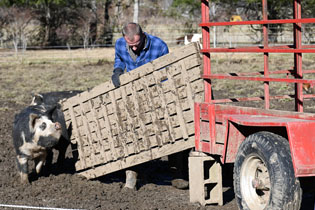
That’s enough to keep any couple occupied. But caring for the farm’s chickens, goats, cows, hogs, and turkeys isn’t just a matter of feeding, watering, and hoping for the best. Keeping the animals healthy – and vet costs down – requires daily vigilance and interaction. Plus, happy animals are cooperative animals.
“There isn’t a day that goes by that I don’t scratch every hog on this farm behind the ears – this keeps me in touch with our animals and means I pick up on early warning signs of disease or other changes in the litters and drifts,” Jeremy says. “This is also an important bit in the relationship development with my four-legged bulldozer toddlers. Having them not only used to but desirous of my company maintains stability in the social order on the farm.”
The concept of a social order requires a bit of flexibility and acceptance from the hogs’ owners. “Four-legged bulldozer toddlers” isn’t merely a joke. “Those hogs watch everything we build for them, and as soon as we’re done, they try to destroy it,” Natalie laughs. “Which is why we’ve adopted the concept of ‘good enough is perfect’ from (well-known regenerative farmer and author) Joe Salatin. The hogs get shelter from spare parts.”
“The hogs want to be included. They may be destined for the dinner plate, but every single one of them is a pet first,” Jeremy clarifies. “We call it 'pets with a purpose' or 'the best tasting pets you’ll ever ‘meat’.”
Dad jokes notwithstanding, Jeremy is serious about his passion for locally produced, ethically sourced food. A longtime barbecue aficionado, he knows the importance of starting with a good cut of meat. “Many years ago, I gave up on grocery store butcher cuts – not fresh, poorly cut, and factory injection of the meat with a saline solution prevents proper brining techniques and gives the meat a mushy chemical texture and flavor,” he recalls. He turned to local farms, but sourcing the product he wanted was inconsistent. With the family already raising several other animals, the solution seemed obvious: The Alisons added a few hogs to the farm.
“It didn’t take too long watching those hogs running around and playing to realize that I really enjoyed them, so I set off in search of a registered boar and sow. My first boar was actually a birthday present from Natalie.”
Speaking with Jeremy, it’s clear that a love of food starts with a love of the animals. He describes his Idaho Pasture Pigs as, “Incredibly docile…My 500-pound boar will lie down and roll on his back for you to scratch under his chin! People who haven’t had the pleasure of spending time with pigs should find a way to do so. In addition to being incredibly smart, their zest for the joys of play and social life is both inspiring and entertaining to observe.”
A calm and friendly temperament makes management of the hogs easier, but Jeremy’s chosen breed also produces a higher quality of sustenance than typically found in stores. The hogs are primarily grassfed – unusual in hogs, and obviously impossible in factory farm settings – and produce meat that “more closely resembles a good steak in raw color. The diet and slower growth nature of these animals set beautiful coloration and flavor in the meat.”
Now that the hogs consistently produce litters, the Alisons can feed not only Jeremy’s barbecue cravings but also supply the community with fresh, humanely raised pork. The process for obtaining this meat, however, is not so simple as a quick trip to the grocery store.
“Due to government regulation and the difficulties we’ve had as a low-volume producer maintaining a relationship with a processor, the only way to buy pork from our farm is by the whole or half hog,” Jeremy says. “When a new litter of piglets is born, Natalie posts the available pork shares on Facebook. Once these slots fill up, they’re gone.”
At around ten months of age, the hogs are grown to about 250 pounds and ready for what the Alisons call their “one bad day.” After a life spent breathing fresh air under Appalachian skies – as opposed to a caged existence on the concrete floor of a warehouse – the hogs take a short ride to a processing facility. In just a few hours, their purpose is fulfilled, and grateful families enjoy the healthiest, most flavorful pork they’ve ever tasted.
Similar principles apply to the farm’s free-roaming turkeys, who also enjoy a life in stark contrast to commercial fowl. According to the National Turkey Federation, Americans consume approximately 46 million of the birds on Thanksgiving Day alone. The vast majority of those lives are spent indoors, in crowded conditions, without access to the varied diet turkeys would normally enjoy outside. Those in Western North Carolina who prefer a holiday without guilt can purchase a heritage-breed, free-range turkey from family farms like the Alisons.
State regulations once impacted another of the Alisons’ goals. The family prefers to use raw milk due to its health benefits, but sales for human consumption are not permitted in North Carolina. Sold for use in pets only, raw milk is more difficult to source and, due to scarcity, ends up priced at about 18 dollars per gallon. Just across the state line in South Carolina, where raw dairy is permitted and sold more freely, gallons go for a more reasonable 9 dollars – but the drive is hardly worth the time and expense.
“It was more cost-effective to buy my own cows and milk them myself,” Natalie jokes. With three children in the household and multiple animals to feed, milk never goes to waste. Natalie churns the milk into butter or turns it into cheese and yogurt. Whey, the byproduct of this process, is given to the hogs for additional nourishment. Everything on the farm is put to good use.
Expanding on the extent of what one family can accomplish on just four acres, Natalie clarifies that much of their meat comes straight from their own hard work. In addition to the hogs, the family raises meat goats and rabbits, excess roosters are culled from the flock, and their freezer stays full. Eggs from the backyard hens round out the family’s protein needs.
She has enough to keep her busy, but in the summer, Natalie also preserves much of the vegetables the family eats throughout the year. With their land dedicated to raising animals, she sources fresh produce from other local farms. Long days – and often nights – are spent in front of the stove, water-bathing or pressure-canning the glass jars of tomatoes, beans, carrots, and other veggies that line the family’s pantry.
Healthier, ethical food is sometimes regarded as a fringe movement or even (perhaps absurdly and definitely unfairly) viewed as a political statement in the United States. Meanwhile, the cultural climate and differing government regulations of Europe make these values the norm there. Already well educated on the differences between American and European food production, the Alisons found themselves even more inspired to create change after visiting Austria and Germany in the fall of 2025.
Reflecting on those disparate attitudes, Jeremy elucidates the point. “Europeans don’t know what ‘grassfed beef’ means, because their farmers wouldn’t dream of feeding cows anything aside from their natural diet.” Illuminating the distinction between a typical American diet and the minimal processing of European foods, he observes that “the ingredient lists of grocery items in the EU are shorter and more palatable. A glance at labels provides provenance and useful ingredient information.”
The facts are on Jeremy’s side. According to the Center for Health Law and Policy Innovation at Harvard Law School, an estimated 10,000 food additives are approved for use in the U.S. By contrast, the European Union allows only 411 such ingredients.
For those who haven’t experienced the difference, Jeremy sums it up quite simply. “The food there actually tastes like food. Food that is alive and vibrant.”
As the American food chain evolves, the Alisons are on board to facilitate change in Western North Carolina. “On an enterprise level, we have plans for more farmland, buildout of processing and retail facilities on the farm for better control end-to-end, and even retail small-producer charcuterie in the Bavarian style we’ve come to know and love,” Jeremy predicts.
“On a community level, we’re looking at creating educational material centered around sustainable homesteading involving our chosen breed of hogs. There’s a lot you can do with one of these animals without using refrigeration to preserve it.”
A simple walk around Able Farm provides all the convincing any consumer could require. At a time when numerous film documentaries portray the stark, inhumane reality of factory farming, the Alisons provide a real life for every animal on their farm. As the children practice soccer skills, drive the family’s tractor, and splash happily in the creek, likewise, the animals enjoy a happy existence in their own way. Free to roam, nourished by a healthy diet, and given daily individual attention, these “pets with a purpose” know only blue skies, fresh air, and peace.
And when that “one bad day” arrives, the Alisons give thanks for each animal’s life. In exchange for hard work and sacrifice, the family enjoys food that is both physically and spiritually nourishing.
As Jeremy reflects, “All of this embodies our desire for our family, friends, and community to fully enjoy the richness of God’s provision and the strong agricultural heritage we are so fortunate to be a part of in western NC.”
Follow the Alisons’ journey on Instagram @ablefarmnc or on Facebook via Natalie’s personal page (Natalie Alison). Order ethical, sustainably-raised pork from Jeremy through Appalachian Pork Products
https://share.googleNNdTeaNRLTpLKcgtZ. Or email ablefarmnc@gmail.com