Hummingbirds Return to the Plateau
03 Apr 2026
Love and courage, no matter how small, can save the world
Plateau Magazine April-May 2026
Written By: By Kingsley Guy
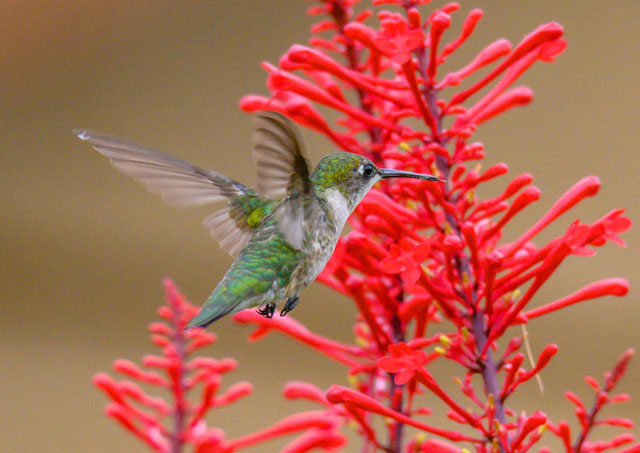
A welcome visitor has returned to the Plateau—the ruby-throated hummingbird, a magnificent creation of nature that pushes the boundaries of what is biologically possible. With its wings humming, the ruby-throated hummingbird can fly up and down, backward and forward, and even hover like a helicopter as it draws nectar from flowers and backyard feeders with its elongated beak and tongue.
In her poem “A Route of Evanescence,” the poet Emily Dickinson describes the ruby-throated hummingbird as having a “Resonance of Emerald,” referring to its resplendent green back, and a “Rush of Cochineal,” alluding to a crimson dye similar in color to the throat of the male. Depending on the angle of the light, the throat will mimic the ruby in its dancing optical effect.
The ruby-throated hummingbird is the only variety that makes the Eastern United States and Southeastern Canada its seasonal home. While a dedicated bird watcher might catch a fleeting glimpse of another variety, such sightings are extremely rare.
Brock Hutchins, president of the Highlands Plateau Audubon Society, captured a picture of a rufous hummingbird last fall at a feeder in the Wildcat Cliffs development. “The rufous is found in the Northwest,” he said. “Finding one here is one of those things about nature that is hard to understand.”
Hummingbirds accomplish their flying acrobatics through the rapid beating of their wings, from 50 to 80 times a second for the ruby-throated variety. In order to provide oxygen sufficient to power its wings, the bird’s metabolism is incredibly high. When hovering or in rapid flight Its heart rate can climb as high as 1,200 beats per minute, possibly the highest of any vertebrate.
Consequently, hummingbirds — with an average weight just a bit more than that of a penny — constantly search for food during daylight hours. Some might even visit a thousand different flowers in a day. The hummingbird also consumes insects, a source of protein especially important during the nesting season and in preparation for migration.
At night, however, the hummingbird can rest. Its heartbeat drops to a fraction of what it is when active, and it enters a temporary hibernation, or torpor, until the sun rises. Unfortunately, this is also a time when it is most vulnerable to predators, which include house cats and snakes.
Given the incredible nature of hummingbirds, it’s only natural that they would become the subject of legends for the indigenous cultures of the Americas. The Aztecs saw warlike features in hummingbirds, but for the Cherokee of the Southern Appalachians, the hummingbird was a symbol of harmony.
Tribal healers believed hummingbirds brought healing qualities to plants used in medicines. Also, as Cherokee legend has it, a hummingbird braved a dangerous journey to a far-off land to bring back a tiny ember that gave humankind fire. The heat from the ember extended the bird’s beak and gave the throat its ruby-red glow.
The gods punished Prometheus when he gave fire to the Greeks. By contrast, the Cherokee still honor their “Prometheus” with the saying: “When a hummingbird appears, remember that love and courage, no matter how small, can save the world.”
Note that the birds are not always harmonious with each other. In fact, they can be quite territorial, fighting over access to flowers and feeders. The standard ratio of water to sugar for the feeders is 4:1, but a word of caution: The mixture should be clear, not red, since the dye is unhealthy for the birds, and the feeders should be washed at least every three days to keep diseases at bay.
Bears, which in recent years have grown in number on the Plateau, enjoy the sugar mixture as much as hummingbirds. For this reason, many bear advocates discourage the hanging of bird feeders, warning that they foster a dependence on humans that draws bears to residential areas, which is beneficial neither to bears nor people.
The cultivation of gardens with plant species that attract hummingbirds can serve as an environmentally sound alternative to feeders. Sonya Carpenter, a strong advocate of this approach, designed the pollinator garden by Lindenwood Lake at the Highlands Nature Center. Last year, Carpenter and her husband, Canty Worley, incorporated Co-Habitate, a non-profit organization designed to foster an understanding of the importance of living in harmony with nature.
“Hummingbirds are attracted to flowers with bright colors such as red, orange, and pink,” says Carpenter, adding that tubular or trumpet-like flowers are especially inviting since they tend to hold more nectar than other varieties.
“Bee balm, cardinal flower, and coral honeysuckle attract hummingbirds and grow well in this area,” she says. She also recommends jewel weed, a late-blooming flower that hummingbirds love. “You won’t find it in nurseries, but it’s easy to grow from seeds.”
As the arrival of the ruby-throated hummingbird is a harbinger of spring, its departure, from late July to early October, is a signal that the forests are preparing for their winter sleep. For many, the journey to their seasonal home in southern Mexico and Central America will take them across the Gulf of Mexico, a 500-mile trip in which they must keep their wings flapping nonstop for as much as 24 hours. Of this Herculean task, it’s fair to ask: “How is this even possible?”
For the next several months, however, ruby-throated hummingbirds will be calling the Highlands-Cashiers Plateau home. By any measure, they are magnificent neighbors, invoking in many humans a near-hypnotic sense of awe and wonder.
Fascinating Facts
Hummingbirds are the only birds that can fly backward and hover in place.
Their wings beat 50 to 80 times per second, creating the humming sound.
A hummingbird’s heart can beat more than 1,200 times per minute during flight.
They have excellent color vision and can see ultraviolet light.
Some species migrate over 2,000 miles each year.
The smallest hummingbird, the Bee Hummingbird, is about 2 inches long and weighs less than a penny.
Hummingbirds also eat small insects and spiders for protein.
Plants That Attract Hummingbirds
Choose tubular flowers, which match the shape of their beaks.
Native plants are best, as they provide consistent nectar sources.
Plant in clusters instead of single plants to make your garden more visible from above.
Aim for blooms that flower in succession so nectar is available from spring through fall.
FEEDER TIPS
Use a simple nectar mix of 1 part white sugar to 4 parts water. Do not use honey or artificial sweeteners.
No red dye. It can be toxic.
Clean feeders every 2 to 3 days in hot weather to prevent mold.
Hang feeders in partial shade to keep nectar from spoiling too quickly.
BIRDWATCHING AND PHOTOGRAPHY TIPS
Early morning and late afternoon offer the best light and most activity.
Set your camera to a fast shutter speed to freeze wing motion.
Use burst mode to increase your chances of capturing sharp action shots.
Position yourself near a feeder or favorite flower and remain still. Hummingbirds will acclimate to your presence.
Add a perch near your feeder. Birds often rest briefly, giving you a perfect photo opportunity.