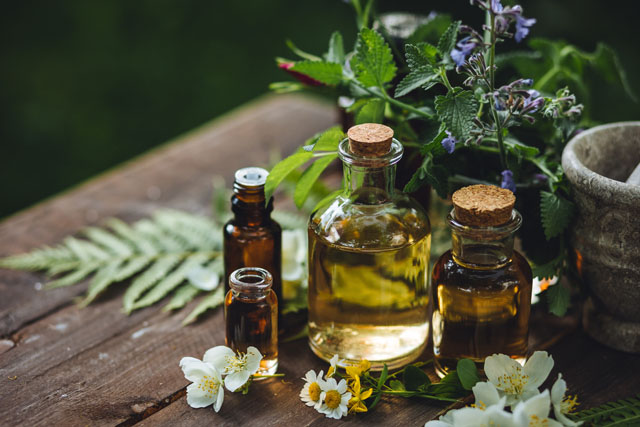
The Simple chemistry of healthy skin
05 Oct 2026
Rachel Blalock of Naturally Connected Life cuts through clean beauty claims
Plateau Magazine October-November 2026
Written By: By Emily O’Brien | Images: Photos provided by Naturally Connected Life
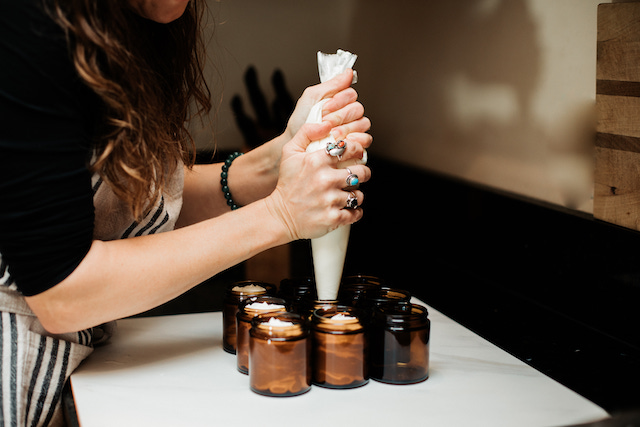
There is a particular kind of confidence that comes from making something with your own hands, batch by batch, and knowing exactly what went into it. Rachel Blalock has that confidence. As the founder of Naturally Connected Life, she formulates every product herself— tallow balms, botanical hydrosols, and infused oils— and can name each ingredient. In a market crowded with “clean” and “natural,” her approach is refreshingly literal: If she can't explain what something is and why it's there, it doesn't go in the jar.
“Most of the things that I use are actually edible,” she says.
“They might not taste good, but you could consume them.”
That instinct, to actually read and understand a label, is one dermatologists increasingly encourage, too. The FDA doesn't formally define “natural” for cosmetics, which means the word can legally appear on a product with almost any ingredient list behind it.
WHAT THE LABEL DOESN'T TELL YOU
Blalock is skeptical of how the word "natural" gets used in the beauty aisle. To her, it has become more of a marketing shorthand than a meaningful claim. “It doesn't mean exceptionally much,” she says. “In a lot of over-the-counter skincare products, it's more like, ‘We took out these really harmful things.’” A bottle can call itself natural simply for what it omits, often sulfates or parabens, while still containing plenty of ingredients most people couldn't identify.
Her own litmus test is simpler than any certification. “If you can't identify what the word is, I would question it,” she says. “If it's some sort of product that has a list of 60-plus ingredients... and you can't pronounce any of the words, then it's not an exceptionally natural product.” In her own formulations, only two ingredients fall outside plain language—and she's particular about how even those are sourced.
That said, an unpronounceable name isn't automatically a red flag. Plenty of well-studied, dermatologist-recommended ingredients, such as tocopherol (vitamin E), sodium hyaluronate (sodium salt of hyaluronic acid), and niacinamide (vitamin B3), all sound clinical but are gentle and effective. The more useful habit is learning what a handful of common ingredients actually do, rather than judging a label by how easy it is to pronounce.
OILS THAT SOUND BETTER THAN THEY ARE
Ask Blalock which ingredients deserve more scrutiny, and she points to ones that sound wholesome: sunflower, safflower, grapeseed. She says that while they are natural, what ends up making its way into products is an incredibly processed version. These oils are high in polyunsaturated fats, which oxidize easily and need added preservatives to keep from turning rancid. It's part of why her own line leans instead on tallow, along with jojoba and olive oil—fats she considers more stable on the skin.
Polyunsaturated oils are more prone to oxidation than saturated ones, which is why formulators often pair them with antioxidants like vitamin E. Whether that oxidation meaningfully affects skin, properly preserved product is where opinions split; some formulators see it as a real concern, others as a manageable one.
Of course, just because something is of the earth doesn't mean it's inherently good for you.
SKIN MINIMALISM
If there's a single piece of advice Rachel returns to again and again, it's this: less is usually more. “Overwashing or excessive use of products is actually a bigger issue than not taking care of your skin at all,” she says. She's not convinced that twice-daily washing is necessary for everyone, particularly for people who aren't wearing makeup.
It's a philosophy that echoes a broader shift in skincare, often called “skin minimalism”—fewer products, applied more deliberately, in place of long routines layered with actives. Her own recommended routine is spare by design: a simple, low-ingredient cleanser, a botanical hydrosol or mist, and a moisturizer—as few as five total ingredients on the face. It's an approach she leans on especially for people dealing with acne, breakouts, or eczema, where she's found that stripping a routine down often does more than adding to it.
Anything meant to actively exfoliate or resurface the skin should be introduced slowly, a few times a week rather than daily. But someone with resilient skin is simply swapping a synthetic version of a product for a natural one; she's less inclined to insist on a formal patch test, with the exception being sensitive skin.
WHY WATER MATTERS
The insight Rachel comes back to most is the one she says rarely shows up in marketing and has nothing to do with which product you buy.
“Your skin needs H2O in it to absorb fat,” she says, “to absorb and give you moist skin.” Otherwise, it mostly sits on the surface, doing far less than it could.
She sees this most often in people managing eczema. “They'll have a really rough, scaly patch, and they're just putting moisturizer on it all day long, and it's not effectively working,” she says, “because there is no moisture in their skin to get the fat molecules deeper into the skin.” Her fix is to apply moisturizer to skin that's still slightly damp, straight out of the shower or after a spritz of one of her hydrosol mists, rather than to dry skin alone.
It's a version of a technique sometimes called “moisturizer sandwiching,” and it's one of the few pieces of skincare advice that costs nothing and works regardless of what's in the bottle.