A Charming Circle
04 Aug 2026
The Native Plant Celebration returns to Highlands
Plateau Magazine August-September 2026
Written By: By Sarah Vickery | Images: Photos provided by Highlands Biological Station
For two days each September, the Highlands Biological Station gathers the Plateau's plant people to celebrate a landscape that has stopped naturalists in their tracks for centuries — and to look after it. This year's Native Plant Celebration returns Sept. 11 and 12.
Rain is the secret. It falls on the Highlands-Cashiers Plateau in some of the heaviest totals in the eastern United States, and it falls on a tilted shelf of ancient rock nearly 4,000 feet in the sky. Give a temperate landscape that much water, that much elevation, and that many folded coves and seeping slopes to hide in, and it will do something remarkable: it will grow more species of plants than almost anywhere else in the temperate world.
People have been marveling at it for a very long time. Two hundred and thirty-five years ago, in 1791, the Philadelphia naturalist William Bartram set down his account of traveling through these mountains and reached, as so many have since, for language barely adequate to the task. He wrote of a "charming circle of mountain vegetable beauties" — a phrase that still fits, and that the Highlands Biological Station has taken, in spirit, as the heart of its work.
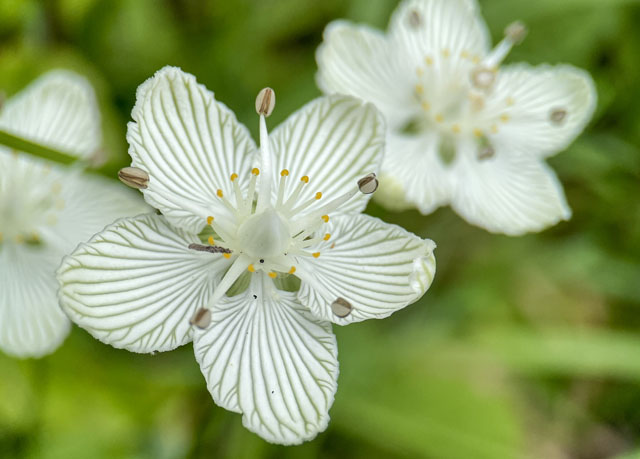
Consider one small emblem of that circle: Shortia galacifolia, the Oconee bells, a low evergreen wildflower with nodding white blooms that grows wild in only a handful of places on earth, nearly all of them within reach of this plateau. Its story is the stuff of botanical legend — collected once in the 18th century, then lost to science for the better part of a hundred years, known to its would-be finders only from a single pressed specimen, and at last rediscovered along a Carolina riverbank in the 1870s. Diversity and discovery: the two are braided together here, and they give this September's celebration its name.
Every two years, the station sets aside a weekend to honor it all. "Diversity and Discovery," its biennial Native Plant Celebration, returns Friday and Saturday, Sept. 11 and 12 — two days that move, deliberately, between the gardens and the mind: a Friday spent among living plants, and a Saturday spent thinking about them.
"This year we're celebrating those beauties in style," says Dr. James T. Costa, the station's executive director. "Our region is renowned for its plant diversity, and there is no better place to learn just how botanically special it is."
Friday belongs to the gardens, and the gardens belong to everyone; the day is free and open to all. In the Highlands Botanical Gardens — a living collection of the region's own flora, threaded with paths through woodland, wetland and meadow — hourlong tours set out through the morning and afternoon, and a native-plant sale runs alongside them. There is something quietly radical about that sale. It invites you to take the Plateau home: to carry a piece of this improbable richness back to your own slope or streambank, and to plant it. Staff members stand ready to help load the heavier finds.
Saturday moves indoors to the Highlands Community Building for a daylong symposium organized around a deceptively simple idea — that the living world rewards more than one kind of attention. The day's three featured speakers might be understood as three doors into the same wonder.
There is the taxonomist's door. Dr. Alan Weakley, director of the University of North Carolina Herbarium and author of the "Flora of the Southeastern United States" — the doorstop reference that a generation of botanists and land managers keeps within arm's reach — has spent a career in the patient, exacting work of naming what grows here. To name a plant precisely is its own kind of devotion.
There is the designer's door. Preston Montague, a landscape architect and artist from Durham, draws the living world as often as he plants it; his botanical illustrations include the art on North Carolina's Venus flytrap license plate, a small daily tribute to one of the state's strangest and most imperiled natives. His argument, made in paint and in planting plans alike, is that a landscape can be at once beautiful, useful, and ecologically generous.
And there is the writer's door. The keynote belongs to David George Haskell, a biologist whose books have twice been finalists for the Pulitzer Prize and once won the John Burroughs Medal for nature writing. His newest, "How Flowers Made Our World," makes a claim large enough to reorder the way you see a roadside in June: that the flowering plants did not merely decorate life on earth but remade it, our own species included. A book signing follows.
Threaded through the day are shorter notes from the gardens themselves — talks on the research and conservation quietly underway in their beds, a first look at projects to come, and an "Ask the Experts" panel for the practical-minded, who want to know what will actually thrive along their own driveway.
The weekend ends the way the best ones do, with a gathering. From late afternoon into evening, a reception gives way to a live auction of rare and unusual plants — local horticulturist Adam Bigelow calling the bids — and the room fills with the particular joy of gardeners bidding on something they have never managed to find anywhere else. Every bid, and every ticket, helps sustain the gardens that made the weekend possible: gardens that ask nothing of their visitors the rest of the year, and stay open, and free, to all.
For Canty Worley, the station's horticultural specialist, that is precisely the point. "This celebration is a rallying point for those of us who have embraced naturalistic landscape design," he says. "Highlands is a benchmark for biodiversity in this region, if not the world, and our historic gardens are a precious refuge for a way of life that is under constant threat from the development and degradation of the land."
The station will turn a hundred in 2027 — nearly a century spent looking closely at these mountains. There are worse ways to approach a centennial than the one it has chosen: by gathering the people who study, grow, and cherish the plants, and by trusting that wonder, carefully tended, renews itself. Bartram's charming circle is still here. For two days in September, it opens its gates.
IF YOU GO
What: "Diversity and Discovery," the Highlands Biological Station's biennial Native Plant Celebration.
When & Where: Friday and Saturday,
Sept. 11–12, in Highlands.
Friday (free, no registration): Native-plant sale, noon–5 p.m., and guided garden tours at 10 a.m., noon, 2 and 4 p.m., on the station's campus.
Saturday (ticketed): Daylong symposium at the Highlands Community Building; doors at 9 a.m. Featured talks — Dr. Alan Weakley at 9:45 a.m., Preston Montague at 1 p.m., and keynote David George Haskell at 3:15 p.m. — plus short garden talks, an "Ask the Experts" panel, a book signing, and a reception with a live plant auction (auctioneer Adam Bigelow), 4:30–6 p.m.
Tickets & Full Schedule
Media contact: Sarah Vickery, Business and Communications Manager, Highlands Biological Station
hbs@wcu.edu · 828-526-2602
Visitor & Contact Information
Highlands Biological Station
265 N. Sixth Street, Highlands, NC 28741
(828) 526-2602
hbs@wcu.edu