Shelton Laurel: An Appalachian Opera
03 Apr 2026
The trials and survival of a mountain community
Plateau Magazine April-May 2026
Written By: By Anna Robertson | Images: Photos by Western Carolina University Photography
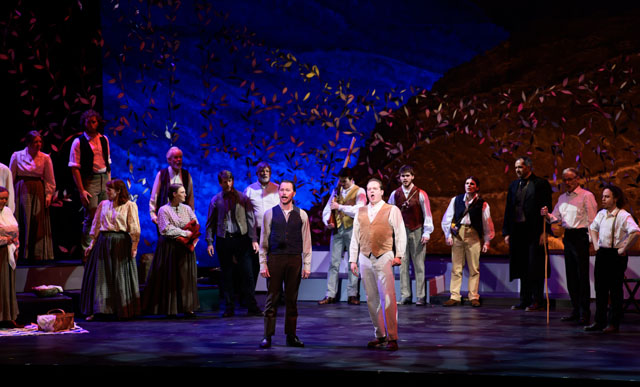
On January 23rd, 2026, fans of renowned Appalachian author Ron Rash were treated to a new treatment of his work in Shelton Laurel: An Appalachian Opera. The one-night-only performance was composed by Dr. Damon Sink, who wrote the libretto inspired by Rash’s short stories and poems.
The Shelton Laurel Massacre of 1863 is a footnote of Civil War history in North Carolina. Rash first brought it to life through his novel The World Made Straight. Of Rash’s twenty books, a few have been adapted for plays, movies, and even graphic novels. But opera was a first for him. Not all past adaptations of Rash’s work have done his work justice. But he seems moved and humbled at how well the Shelton Laurel opera hit at the core of his storytelling.
When we meet, I ask him how it felt to see his work in this way. “Very appreciative that so many people spent so much time creating this amazing event,” he reflects. “Every aspect was well done, the story, the libretto, the music, the set design.”
Damon Sink, music professor at Western Carolina University, has an office two floors down from the Parris Distinguished Professor in Appalachian Studies, although the two had never properly met until conceiving the opera. Sink tells me that he had always wanted to do an opera inspired by the fugitive poets, whose work drew from rural southern imagery and helped lay the foundation for southern literature. Once he mentioned this idea to a colleague, it was suggested that the two scholars connect. Rash quickly suggested the story of the Shelton Laurel massacre as a good subject.
“Within 10 min he was taking books off the shelf and saying, ‘use whatever you want’ and I was just blown away by his generosity.”
Sink went on to study Rash’s poems and short stories in depth and developed a narrative that wove together Rash’s work set in the Shelton Laurel community, leading up to and during the Civil War. The audience witnesses Rash’s short stories “The Baptism” and “Neighbors” from his collection In the Valley and “Lincolnites” from the collection Burning Bright, as well as the poems “Shelton Laurel” and “Madison County: 1864” from Poems {New and Selected} on stage through music.
The Shelton Laurel Massacre of 1863 was a shockingly violent incident, even in the context of the bloody Civil War. Residents of the small Madison County community of Shelton Laurel sided with the Union, many with ancestors who had fought in the American Revolution and still felt the scars of that bloodshed. Madison County became deeply divided on the secession vote, with a strong Confederate sentiment in the nearby town of Marshall. It’s hard to say where the local conflict between communities began, but it culminated with the capture of 13 men of the Shelton Laurel as prisoners by the 34th regiment of the Confederacy, led by Lawrence Allen and others from Madison County. The troops marched the men toward Knoxville, before stopping and ordering them to stand side by side, and then shooting them one by one. The youngest victim was a 13-year-old boy.
The murders became such a blight on the Confederacy in North Carolina that it prompted a rebuke from Governor Zebulon Vance, and leaders of the 34th were reprimanded. Sink chose to take the focus away from the abject violence of the actual massacre and give life to characters who tell the story of a community weathering the fractured United States conflict up close.
“The violence of something like that is not what I want to have on stage. The massacre itself is just a tragedy, and the bigger story is how being involved, or being there at that time, affected a person.”
The opera opens with a lovely, leafed silhouette backdrop and a church congregation engaged in shape note singing, a scene reminiscent of a brush arbor. Characters from Rash’s short stories become recognizable members of the Shelton Laurel community, as well as a few characters invented by Sink.
Sink has already begun packaging the production and script to be sold and reproduced by other universities or opera companies for future performances. He even hints that a second act to the opera is in the works, which will center on a character who appeared in the opera as a baby named “Marshall.” Sink plans to have Marshall grow up and take on the nickname “Mars” to further bring regional characters to life.
The night of the production, I spot the author and retired professor, Pam Duncan, making her way to her seat, when she asks me,“What do you figure them folks from the Shelton Laurel would have to say about all of us getting together tonight to see an opera about them?”
Later, as I make my way over the mountains home to north Georgia, I ponder her question as sit with the sounds and music of the night’s stories. But I am distracted by my own crisis, a coming ice storm, and worry that enough has been done to secure my home in case of power outage or frozen pipes.
The answer arrives: To celebrate the survival of a community through art fortifies our own strength and gratitude. That’s what I think the people who lived through the Shelton Laurel massacre would think. They would be thankful that they survived.