Perseverence
03 Aug 2026
Honoring the past and imagining the future in Cherokee
Plateau Magazine August-September 2026
Written By: by Kingsley Guy | Images: Photos provided by Museum of the Cherokee People; Bob Scott
For some travelers, Cherokee is a North Carolina mountain town of souvenir shops, a Harrah’s Resort and Casino, and the gateway to the Great Smoky Mountains National Park.
Cherokee, however, is far more than that. It is the heart of the Qualla Boundary, the 57,0000-acre homeland of the Eastern Band of Cherokee Indians, where thousands of years of history, tradition, and perseverance continue to shape everyday life.
Cherokee is less than a 90-minute drive from the Highlands-Cashiers Plateau, so if you enjoy learning about the history of the area in and around where you live, and want to have fun in the process, a day or two spent in Cherokee is well worth your while.
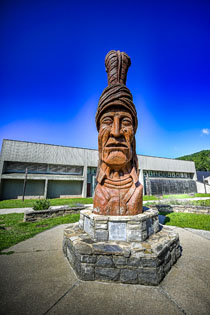
The best starting point for the adventure is the Museum of the Cherokee People, located in the center of town, not far from the Oconaluftee River. Exhibits detail the history of the Cherokee from pre-Columbian times through European contact to the present day. Founded in 1948, it’s one of the oldest and best Native American museums in the United States.
Visitors learn about Sequoyah, who in the early 1800s developed an 86-character syllabary for the Cherokee language, quickly raising the literacy rate among the Cherokee to among the highest of any ethnic group in the country.
Another exhibit explains the seven clans that formed the foundation of traditional Cherokee society and still play a role to this day. They include the Wolf Clan—the warriors and protectors of the tribe; the Deer Clan—hunters and messengers; and the Bird Clan—spiritual communicators and storytellers.
Exhibits feature the Trail of Tears, the infamous forced migration beginning in 1838 of an estimated 16,000 Cherokee from their ancestral homeland to Oklahoma, a march that cost the lives of as many as a third of those expelled. Visitors also learn about the roughly 1,000 Cherokee who escaped the tragedy mainly by retreating into the mountains and later, with the help of outside supporters, purchasing land and rebuilding their tribal homeland within the Qualla Boundary.
“We are making the museum a first-person experience,” says Executive Director Shana Bushyhead Condill, pointing out that pronouns “they, them” are being replaced in exhibit signage with the first-person “we, us” to reflect a Cherokee, rather than an outsider, orientation of the museum. “We're also emphasizing the present tense rather than the past tense in the displays to show that Cherokee culture is alive and progressing and not something that existed only in the past.”
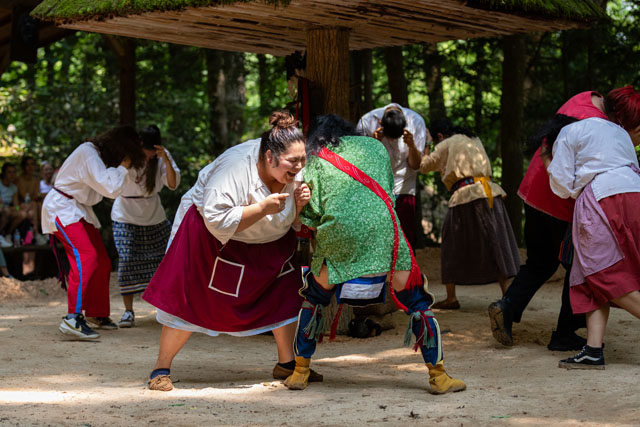
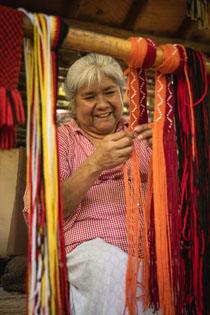
A mile away sits the Oconaluftee Indian Village, a “living museum” established in 1952 by the Cherokee Historical Association. Guides lead visitors through the wooded path of a Cherokee village as it might have looked in the mid-18th century. Tribal members demonstrate traditional skills such as pottery making, beadwork, and weapons making.
Visitors enter recreations of traditional dwellings and listen to talks about Cherokee traditions in the seven-sided Council House. Tribal members also perform the corn dance, buffalo dance, and other social dances for the visitors. (Note: The ritual and ceremonial dances are reserved for strictly tribal settings.)
The enthusiasm of the guides and presenters is palpable, with all of them eager to talk with their guests about Cherokee culture. Chaz Martens, just now finishing high school, is among the most loquacious of the guides. He plans on studying filmmaking in college. “I take a lot of pride in my culture and teaching others about it,” he says. “I was born into the Bird Clan, the storytellers. Maybe that’s why I enjoy sharing stories and want to be a filmmaker.”
As night falls during the summer months, the open-air Mountainside Theatre, located next to the village, springs into action with the presentation of the dramatic pageant Unto These Hills. With the exception of the 2020 COVID year, it has operated continually since 1950—an impressive 76-year run!
Historical figures come to life as the drama traces the experience of the Cherokee from the earliest days of European contact, through the Trail of Tears, to the re-establishment of the traditional Cherokee homeland. The fact that the drama is presented on the same land where the triumphs and tragedies of the Cherokee actually took place adds poignancy to the performance.
A visit to Bearmeat’s Indian Den, a throwback to the trading posts that used to dot the mountain landscape, provides yet another glimpse into Cherokee life. “I named the store after my great-great-grandmother,” says David Smith, a tribal member who founded Bearmeat’s 35 years ago after the wear and tear of construction work forced him to seek another way to make a living.
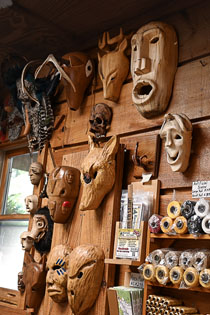
Smith advertised in a local newspaper for Cherokee artists and craftsmen interested in providing their wares on consignment. Today, the shop, located about eight miles from downtown Cherokee, is filled from floor to ceiling with original Cherokee creations for sale, along with historic items just for exhibition. “People who came here years ago as young children with their parents are still coming back,” Smith notes with a hint of pride.
The National Park Service’s Oconaluftee Visitor Center, located three miles from downtown Cherokee and just outside the Qualla Boundary, serves as the main North Carolina entrance to Great Smoky Mountains National Park.
Adjacent to it is the Mountain Farm Museum, consisting of a farmhouse, smokehouse, corn crib, blacksmith shop, and other buildings that give visitors a sense of what farm life in the Smoky Mountains was like in the late 19th and early 20th centuries. During the warmer months, park rangers and volunteers demonstrate blacksmithing, food preservation, ploughing, and other skills used by the farmers of the time.
The buildings aren’t replicas. They existed on tracts purchased for the park when it was created during the 1930s, dismantled and painstakingly reassembled to create the museum. A 45-minute walking tour can instill in visitors respect for the perseverance of the people who scratched out a living in this hardscrabble land.
Visitors in the early morning and before sundown might even catch a glimpse of elk emerging from the forest and into the field, something that had not been seen for 200 years. By the beginning of the 19th century, elk had been hunted to extinction in the Southern Appalachians, but in the early 2000s, the park service began introducing breeding stock. Today, an estimated 150 elk reside inside the park, with perhaps another 125 roaming through adjacent land.
“We ask people to stay at least 25 yards away from the elk and to back off even farther if they notice any erratic behavior,” cautions Park Ranger Emily Martin. That’s sound advice since male elk can reach 850 pounds or more.
The Visitor Center and Mountain Farm Museum also serve as the northern entrance to the Oconaluftee River Trail, a 1.5-mile easily walkable greenway through hardwood forests that links the park and Qualla Boundary. A bit farther downriver is the Oconaluftee Islands Park, an elongated island near the center of town accessible from shore by two distinctive wooden bridges.
Both the trail and the park are ideal places to observe the richness of nature and to appreciate how important the Oconaluftee River was, and still is, to the economic and spiritual life of the Cherokee.
Clearly, there’s plenty to learn and to do in Cherokee. With just 50 miles separating the Highlands-Cashiers Plateau and the Qualla Boundary, it’s worth the effort to bridge the gap.