Our Immortal Moon
03 Oct 2026
A history of lunar lore in Highlands and elsewhere
Plateau Magazine October-November 2026
Written By: By Stuart Malcolm Ferguson
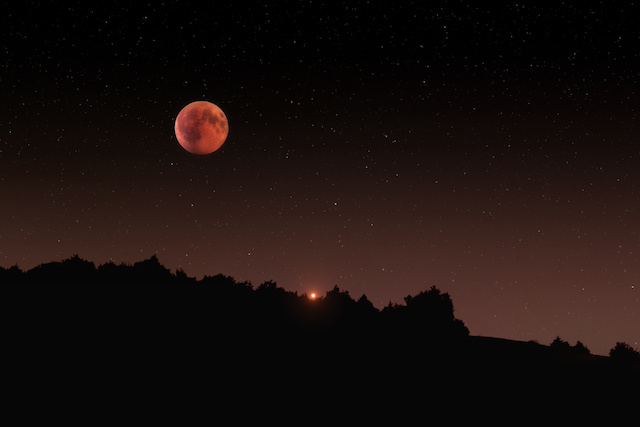
Grab yourself a Moon Pie and look up at the sky! The October full moon—the Hunter’s Moon—is on the night of the 25th; in November, the Beaver Moon falls on the 23rd.
Humans long believed the moon influences the Earth and, of course, were right—just look at the tides. “Moon worship in pagan religions was second only to sun worship,” notes one authority. Roman poet Virgil, in the Georgics, his verses on rural life, advises readers to “mark well the Moon’s phases and the weather signs.” Egypt’s Queen Cleopatra named her daughter—Marc Antony was the father—Cleopatra Selene. (“Selene” derives from the Greek word for moon.)
My copy of Scottish Folklore and Folk-Belief by F. Marian McNeill (which once belonged to Highlands actress Collin Wilcox Paxton) notes that on old tombstones in Scotland “we find a curious device—two crescents set back to back, representing the last quarter of the old moon and the first quarter of the new. This is an ancient Pictish symbol of immortality: the moon died and was re-born every month.”
In the Old World, the Sun was viewed as masculine and the Moon feminine; in the Americas it was the reverse: The Cherokees believed the Moon to be the brother of his sister the Sun, because only a man would be out wandering all night, according to James Mooney’s 1891 ethnology, History, Myths, and Sacred Formulas of the Cherokees. Their term for both the Sun and Moon was nûñ’da’, which they modified by noting whether it was of the day or night.
James Adair was a Scottish trader among the Cherokee and married one; his 18th-century History of the American Indians is invaluable, despite its thesis that his wife’s folks descended from the lost tribes of Israel. Adair described the 1736 lunar eclipse: “They all ran wild like lunatics, firing their guns, whooping and hallooing, beating of kettles, ringing horse bells and making the most horrid noises that human beings possibly could…this was done to assist the Moon.” Mooney would explain that when there were lunar or solar eclipses, the Cherokee ascribed it to a giant frog trying to eat the heavenly body, and so they needed to scare off the monster by making loud noises. It seems to have worked.
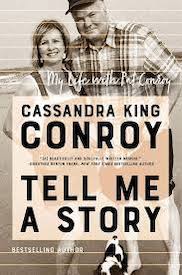
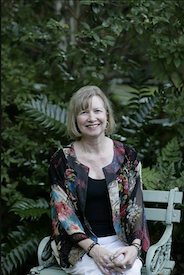
It was during a full moon almost 20 years ago that novelist Cassandra King Conroy attended what must have been one of the more unusual gatherings in Highlands. Ever since I read about it in Tell Me a Story, her moving 2019 memoir of life with her late husband, the writer Pat Conroy, I’ve been intrigued: One summer night in 2007, when the moon was full, about a dozen people gathered at a house on Little Bear Pen Mountain, just before midnight. Then, holding candles, they were led by Sudie—a healer and medium from the famed spiritualist camp in Cassadaga, Florida— to a nearby clearing in the midst of a Rhododendron thicket. Sudie formed the group into a circle and told her acolytes to “hold our arms over our heads and open them up in a bowl shape to channel the energy of the moon,” as Cassandra remembered it in Tell Me a Story.
Cassandra was recently in Highlands for a few weeks—renting a guesthouse right there on Little Bear Pen, taking a break from the heat and humidity at home in Beaufort, South Carolina, and working on a cookbook full of recipes and stories. I went up to see her and learn more about that moon gazing ceremony she witnessed.
Cassandra explained that Madam Celest, a character in her novel The Sunday Wife, is a psychic, and so she did a lot of research to write the part, studying various means of divination and attending séances. In fact, she told me, “I tell fortunes using Tarot cards.” Because she’s a great storyteller, I envy her querents. This sort of fortune-telling isn’t a dark art, but more of a Rorschach test.
Cassandra is open to unexplained influences and is sure that Pat’s office in their Beaufort house is haunted. “It’s always the coldest room and my grandkids are afraid to go in because the lights flicker.” Friend and fellow novelist Mary Alice Monroe came to visit Cassandra after Pat’s death and asked to spend the night in his study, so Cassandra obliged, setting up a day bed. The next morning Monroe said, “Pat woke me up in the night with those clanging windchimes,” which hung outside. Mary Alice told Cassandra that she then got up and stuck her head out the window, only to find the typical, breathless air of summer in the Low Country—no breeze at all. Which is funny, because Pat Conroy poo-poohed the New Agey and esoteric. In fact, he kidded Cassandra when she set out to attend the ceremony that night in 2007: “Don’t let the werewolves get you!”
After sharing her lunch of homemade couscous featuring basil from neighbors Paula and Harry McDonald’s garden, followed by banana bread (both were incredible, and are in the forthcoming cookbook), Cassandra led me down the road on Little Bear Pen. We didn’t have to walk far before we came to a giant tangle of Rhododendron. “It was 20 years ago, but I think this is the place,” she said. We went a short way in and found a clearing and some bushes beaten down on the side. “That must be the den of the bears,” always wandering around the mountaintop there, she warned. It’s good to know that geographic features here live up to their billing! But as Cassandra describes it in her book and then to me in person that afternoon, there was nothing ominous about her full-moon gathering there.
Sudie led the procession down the street and into the woods, “chanting in a sing-song voice as we walked.” Once they arrived, Sudie spread the light from her candle to all the others’. The moon seemed to hang right above the medium’s head as it cast its white light over everything. “It was an absolutely perfect night,” Cassandra wrote, “without a cloud in the ink-black night.” Sudie told them about the Moon goddess who imparted creative energy to her supplicants on this night and the mythical circle of death and rebirth. Then she instructed them to blow out their candles and raise their arms to receive the moonlight, as described above. The gathering could each respond in kind, doing as they were so moved.
“Something magical happened.” Cassandra felt a “jolt” of “strange energy” flowing through her. Despite the other people near her, it was just the “Goddess Moon, me and the Divine…and it felt right to bow in gratitude and to say a prayer of praise.” After a while, all was silent again, and everyone went back down the street and into the dark and their normal lives.
Strangely, McNeill tells of a Moon rune (not a carved stone, but rather a traditional Gaelic spoken charm) preserved from the Hebrides Islands that seems to echo Cassandra’s experience:
“When I see the new moon/ It becomes me to lift mine eye…bend my knee…to bow my head.
Giving thee praise, thou moon of guidance/That I have seen thee again…
Many a one has passed beyond/ In the time between the two moons,
Though I am still enjoying earth/Thou moon of moons and of blessings.”
The only people Cassandra knew there that magical night were the couple who had arranged the whole thing. Their house was a short stroll in the other direction from Cassandra’s front door. We walked by it in the bright daylight of August and then a little further on to the cottage where neighbor Beverly Howell used to spend the summers, though now it’s missing the giant topiary teapot from her front yard, which sent up steam from its spout like a charming-if-wayward refugee from the Land of Oz theme park on Beech Mountain.
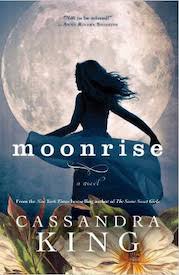
Beverly was not just a real denizen of Highlands, but also a character in Cassandra’s atmospheric novel Moonrise, a sort of Blue-Ridge Rebecca with Garden & Gun Magazine thrown in, set in Highlands on an old estate smothered in ivy—perfect Halloween reading.
Speaking of good books, Cassandra (who is the honorary chair of the Pat Conroy Literary Center) said to make sure to attend the October 14 afternoon event at the Cashiers Library featuring her Beaufort friend, Dana Ridenour. Dana will discuss her new novel about four friends hiking the Appalachian Trail, All the Hidden Pieces, which seems to share a major plot device with Moonrise.